Today is the second anniversary of my mother's death, April 9. I wanted to share again this wonderful tribute that my daughter Katherine wrote two years ago.
I knew her as my Grandma, and I knew her best when I was a kid or a teenager, and that seems to be the only way I can write about her. So. Here is the best composite sketch I can come up with:
She enters the room, and calls out “greetings, greetings.” (Or, if it’s our house in Baldwin, she shakes her head, says “chaos, chaos”, and promptly misplaces her purse.)
She is always, always moving—that’s the first thing you have to know about her. This occasionally verges on the absurd--she used to do laps around McDonald’s by the side of the highway on long trips, and I remember Aunt Sherry once whispering to me “right, no more coffee for you”, as Grandma completed her fourth circuit of the kitchen and stairs on a rainy day in New Woodstock. And when she breaks more bones in the course of a year than the typical casualty rate of a Koch ski trip, or you’re trying to pack up your college doom room, it’s downright unnerving.
But for the most part it’s a very good thing. I don’t know how many countries she went to, or how many lobbying trips to Washington D.C., but I remember our trip to France together; and her descriptions of how Ted Kennedy’s new wife seemed to be doing him good, and which Congressmen were decent guys in spite of being Republicans. And I’ve more than lost count of the times she took my sisters and me to the pool, or the beach, or to visit one of our relatives. But I’ll never forget that the way back from Mark and Maura’s house requires pulling into the Croton Library parking lot and doing a U turn. (At this point, of course, it’s partly because Uncle Mark refuses to tell us the alternate route.)
She also took us into New York City a lot, but the trip to Manhattan I remember the best was the least successful. I was in eighth or ninth grade, and Patricia was in fourth or fifth. Grandma took the two of us and my sister’s best friend into New York for Patricia’s birthday. We were going to Central Park and a museum, I think—I’m not sure because we never got there. Grandma’s route to New York was even more circuitous than the way home from Croton. The Long Island Railroad was too expensive, and parking in Manhattan was right out, so she would drive to a municipal parking lot in Queens where you could park all day for $2, and then walk ten minutes or so to the subway—I don’t remember which station, somewhere near the end of the E line. This time, though, our meter was broken. I suggested we move to another space, but she was not willing to waste those quarters, so she wrote a note and taped it to the parking meter. Unfortunately, in the confusion, she left her car keys sitting on the driver’s seat—she realized this somewhere under the streets of Manhattan.
We turned around, and no one had broken the window or stolen the car. But here, I thought, was an object lesson for Grandma—moderation in all things, including frugality.
She’d have to pay for a locksmith, which cost much more than the extra quarters or, God forbid, a train ticket.
She did no such thing. Instead she asked a rough looking young man on a nearby sidewalk to help her break into her car. He was happy to assist. When he could not get the door open, he called over a friend. Who said, after a few more unsuccessful attempts to pick the lock, that what they really needed was a crowbar, but since he didn’t have his around and Grandma was not crazy about that, they’d better ask another friend. Who said, and I quote, “what we really need is a Puerto Rican.”
I don’t know whether they found a Puerto Rican, and I don’t remember how long we stood there, Grandma smiling encouragingly and offering occasional advice, or how many neighborhood kids were debating the best way to break into a Toyota Camry by the end—it’s probably somewhat exaggerated in my memory. I can tell you that in the end, the simple yet elegant coat-hanger-through-the-window-to-pull-up-the-button-technique did the trick. The lock suffered some damage from the good samaritans’ enthusiastic efforts, but you could get the door open more often than not. And from then on, we parked in the driveway of a high school friend of Grandma’s—10 minutes further away from a subway station even further down the E line, but $2.00 cheaper than the municipal lot and much less risk of a break in.
(As I was writing all of that, I realized---it’s not quite accurate to say she was always moving. I just remembered the nights in Henry Street when she would tuck us in, and tell us to lie still and imagine we were floating on a cloud. There were also her “yoga,” excuse me, ‘yoger” exercises. But if I ever want to finish this, I should move on, so….)
She was incredibly smart, and incredibly interested in the world around her—whether it was the history of the China lobby or when any of her nieces, nephews and grandchildren would finally, in her words “find yourself a mate”.
She also had the strongest faith of anyone I’ve ever known. Maybe it was that combination, that fierce intellect and that certain belief and trust in God, that made her so strong. Much more often than not her beliefs coincided with the Catholic Church, but when they differed she was not shy about saying so…On most of the many nights I slept over at the house on Henry Street, I wore a polyester blend, 1970s issue T-shirt that said in glittery bubble letters “When God Created Man, She Was Only Joking.” And I remember her telling me about sneaking in inclusive language to her frequent readings at St. Martha’s, much to the new parish priest’s chagrin.
And on the much more frequent occasions when her children and grandchildren did something she disapproved of—she let us know in no uncertain terms, but there was never a single moment’s doubt that she loved and accepted us anyway. I’ll always think of her when I read these lines from Shakespeare’s 116th sonnet::
“Love is not love
Which alters when it alteration finds,
Or bends with the remover to remove:
O no! it is an ever-fixed mark
That looks on tempests and is never shaken.”
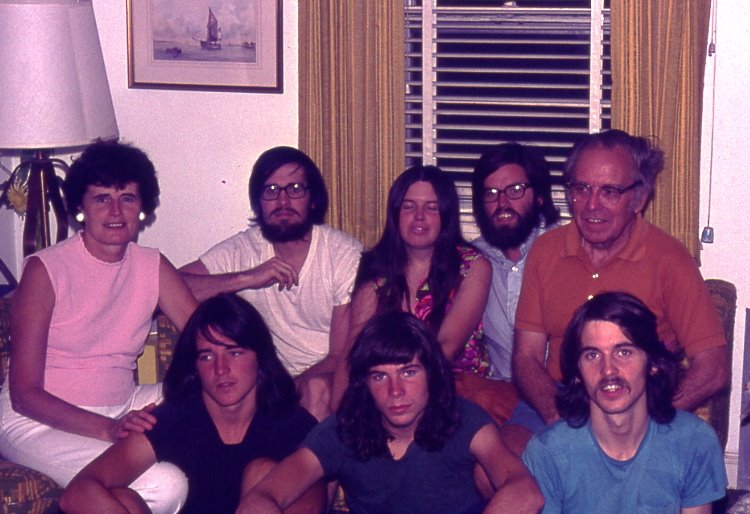
I know, it’s a love poem—and a truly bizarre choice for a description of one’s grandmother. But—getting back to photographs, and with apologies for the embarrassment this may cause certain unnamed relatives of mine--I defy you to find a better or funnier illustration of Shakespeare’s words than the picture posted above of Grandma Mary, Grandpa Joe, and their wayward offspring in the early 1970s:

She was in many ways a third parent to me. I think I’ve spent more time with my husband at this point, but I’m not at all sure of that. She was someone who could be counted on absolutely, without question or condition. She looked on tempests and was never shaken, and I’m not only talking about my uncles’ hairdos when I say that. I don’t think I’ve ever owed as much to, or cared as much about, anyone to whom I expressed it so little. But she was not the most demonstrative person either, so maybe she knew. I lack her certainty about God and heaven, but I hope very much that she knows now.

