Sunday, January 14, 2007

March 6, 1944


My mother's younger brother, Warren, then 10, describes the wedding:
All hell broke loose. This Koch guy was coming home on furlough, and was going to get hitched to my sister. It was Four Koch sisters riotously descended on our 220th Street home, seeking to turn it into a wedding palace - Agnes, Peggy, Mary and Jane! After them, D-Day was a letdown! In preparation for the great day, Frank, Ken and I, now nearly 10, 8 and 12, were sent out across the neighborhood on a foraging mission, a kind of loaves and fishes expedition, to find red ration coupons so there could be meat served at the wedding feast.

March 6th was a brilliantly sunny, crisp day, more spring than winter. At the wedding, my big shot Xavier brother Robert, with his fancy blue uniform and white gloves, got to give away the bride, subbing for Jim who was in the Pacific. At the 220th Street reception, I have a strong memory of being impressed that our pastor, Father Herchenroder, was actually standing in our backyard, in a black leather jacket, talking just like a regular person. After the reception, my sister took off somewhere with Corporal Koch, and we kids went across the street to the more serious business of shooting marbles.

Sunday, April 9, 2006

She Looked on Tempests and Was Never Shaken


Today is the second anniversary of my mother's death, April 9. I wanted to share again this wonderful tribute that my daughter Katherine wrote two years ago.

I knew her as my Grandma, and I knew her best when I was a kid or a teenager, and that seems to be the only way I can write about her. So. Here is the best composite sketch I can come up with:

She enters the room, and calls out “greetings, greetings.” (Or, if it’s our house in Baldwin, she shakes her head, says “chaos, chaos”, and promptly misplaces her purse.)

She is always, always moving—that’s the first thing you have to know about her. This occasionally verges on the absurd--she used to do laps around McDonald’s by the side of the highway on long trips, and I remember Aunt Sherry once whispering to me “right, no more coffee for you”, as Grandma completed her fourth circuit of the kitchen and stairs on a rainy day in New Woodstock. And when she breaks more bones in the course of a year than the typical casualty rate of a Koch ski trip, or you’re trying to pack up your college doom room, it’s downright unnerving.

But for the most part it’s a very good thing. I don’t know how many countries she went to, or how many lobbying trips to Washington D.C., but I remember our trip to France together; and her descriptions of how Ted Kennedy’s new wife seemed to be doing him good, and which Congressmen were decent guys in spite of being Republicans. And I’ve more than lost count of the times she took my sisters and me to the pool, or the beach, or to visit one of our relatives. But I’ll never forget that the way back from Mark and Maura’s house requires pulling into the Croton Library parking lot and doing a U turn. (At this point, of course, it’s partly because Uncle Mark refuses to tell us the alternate route.)

She also took us into New York City a lot, but the trip to Manhattan I remember the best was the least successful. I was in eighth or ninth grade, and Patricia was in fourth or fifth. Grandma took the two of us and my sister’s best friend into New York for Patricia’s birthday. We were going to Central Park and a museum, I think—I’m not sure because we never got there. Grandma’s route to New York was even more circuitous than the way home from Croton. The Long Island Railroad was too expensive, and parking in Manhattan was right out, so she would drive to a municipal parking lot in Queens where you could park all day for $2, and then walk ten minutes or so to the subway—I don’t remember which station, somewhere near the end of the E line. This time, though, our meter was broken. I suggested we move to another space, but she was not willing to waste those quarters, so she wrote a note and taped it to the parking meter. Unfortunately, in the confusion, she left her car keys sitting on the driver’s seat—she realized this somewhere under the streets of Manhattan.

We turned around, and no one had broken the window or stolen the car. But here, I thought, was an object lesson for Grandma—moderation in all things, including frugality.
She’d have to pay for a locksmith, which cost much more than the extra quarters or, God forbid, a train ticket.

She did no such thing. Instead she asked a rough looking young man on a nearby sidewalk to help her break into her car. He was happy to assist. When he could not get the door open, he called over a friend. Who said, after a few more unsuccessful attempts to pick the lock, that what they really needed was a crowbar, but since he didn’t have his around and Grandma was not crazy about that, they’d better ask another friend. Who said, and I quote, “what we really need is a Puerto Rican.”

I don’t know whether they found a Puerto Rican, and I don’t remember how long we stood there, Grandma smiling encouragingly and offering occasional advice, or how many neighborhood kids were debating the best way to break into a Toyota Camry by the end—it’s probably somewhat exaggerated in my memory. I can tell you that in the end, the simple yet elegant coat-hanger-through-the-window-to-pull-up-the-button-technique did the trick. The lock suffered some damage from the good samaritans’ enthusiastic efforts, but you could get the door open more often than not. And from then on, we parked in the driveway of a high school friend of Grandma’s—10 minutes further away from a subway station even further down the E line, but $2.00 cheaper than the municipal lot and much less risk of a break in.

(As I was writing all of that, I realized---it’s not quite accurate to say she was always moving. I just remembered the nights in Henry Street when she would tuck us in, and tell us to lie still and imagine we were floating on a cloud. There were also her “yoga,” excuse me, ‘yoger” exercises. But if I ever want to finish this, I should move on, so….)

She was incredibly smart, and incredibly interested in the world around her—whether it was the history of the China lobby or when any of her nieces, nephews and grandchildren would finally, in her words “find yourself a mate”.

She also had the strongest faith of anyone I’ve ever known. Maybe it was that combination, that fierce intellect and that certain belief and trust in God, that made her so strong. Much more often than not her beliefs coincided with the Catholic Church, but when they differed she was not shy about saying so…On most of the many nights I slept over at the house on Henry Street, I wore a polyester blend, 1970s issue T-shirt that said in glittery bubble letters “When God Created Man, She Was Only Joking.” And I remember her telling me about sneaking in inclusive language to her frequent readings at St. Martha’s, much to the new parish priest’s chagrin.

And on the much more frequent occasions when her children and grandchildren did something she disapproved of—she let us know in no uncertain terms, but there was never a single moment’s doubt that she loved and accepted us anyway. I’ll always think of her when I read these lines from Shakespeare’s 116th sonnet::

“Love is not love
Which alters when it alteration finds,
Or bends with the remover to remove:
O no! it is an ever-fixed mark
That looks on tempests and is never shaken.”

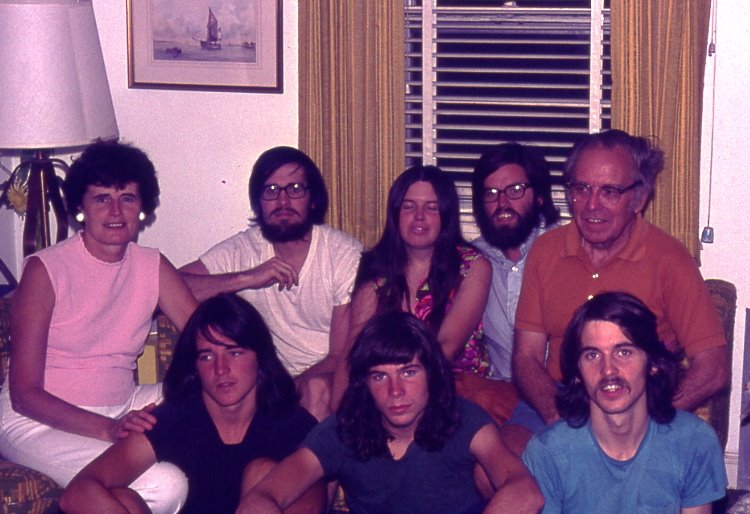
I know, it’s a love poem—and a truly bizarre choice for a description of one’s grandmother. But—getting back to photographs, and with apologies for the embarrassment this may cause certain unnamed relatives of mine--I defy you to find a better or funnier illustration of Shakespeare’s words than the picture posted above of Grandma Mary, Grandpa Joe, and their wayward offspring in the early 1970s:

She was in many ways a third parent to me. I think I’ve spent more time with my husband at this point, but I’m not at all sure of that. She was someone who could be counted on absolutely, without question or condition. She looked on tempests and was never shaken, and I’m not only talking about my uncles’ hairdos when I say that. I don’t think I’ve ever owed as much to, or cared as much about, anyone to whom I expressed it so little. But she was not the most demonstrative person either, so maybe she knew. I lack her certainty about God and heaven, but I hope very much that she knows now.

Friday, January 13, 2006

Joe Meets Mary

Her name was Mary, of course. She was a blue-eyed, smiling, long-legged, cool looking girl--a trifle naive. A girl with class he thought when he first saw her,but young. A bus seems an awful place for things to start, but there was she on a bus going to church and planning to have a chocolate ice cream cone with sprinkelettes. He was going to church too, but she sat in back of him and that was that.

He said hello to her that afternoon or more likely she said hello to him. Again nothing happened--there are lots of shapely girls in blue bathing suits at a lake summer resort. The summer resort was one of those let’s-be-one’big-happy-family sort of places--it even had a social director and a social directrix. Naturally one afternoon there was a baseball game in which all the boys and girls (in those places they’re all boys and girls even if the boys and girls have big boys and girls of their own) were to participate. Well this particular boy and girl were antisocial or mutually social. They sat out the ball game on a raft. Long afterward he learned her reason why she was there but being a romantic still doesn’t believe it.

They talked about prosaic things--families and schools; after all he was a shy young man. She wasn’t. Maybe that is why he was sure it happened then. That’s the trouble with shy young men: they are not used to openhearted friendliness. He never knew what she saw in him, but for the rest of the week they were summer friends. He struggled a little bit--an inherent male instinct. Why one rainy afternoon they went to a Bing Crosby movie in separate groups. They had only a week, not even a full one.

However, this time it did happen on a bus. They had made some sort of plan to ride back to New York on the same bus. He from the summer resort, she from Albany where she was visiting. He was positive. She says it couldn’t haven happened then--that soon.

He didn’t know the proper method of courting a girl, not a beautiful one like her. Oh he was quite proper. The movies he took her to were always approved for adults and children. A baseball game, a few football games, a little bowling--that was about all. He didn’t have much time, altogether three months. He then went away as did twelve million other men young and old. Oh yes, he finally kissed her once. He was very proper and very shy and afraid she would say no.

Thursday, January 12, 2006

In My Grandmother's House

My daughter Katherine wrote this about the wartime letters:

In my grandmother's house, past a stone Mexican statue named Harry, up the front stairs and to the right there is a bedroom. In this bedroom there are a pea green carpet, a bed with yellow and orange flowered sheets, and a cracked blue dresser. This dresser, unlike every other bureau and closet in this house, does not contain any seventies-style ties, old scarves, or early feminist t-shirts. Instead every drawer is filled with letters.

Joe lived in Jamaica, Queens, with his parents and six younger sisters and brothers. His college yearbook said of him, "Even his own brilliance could not fathom the enigma that is Joe." Mary lived in Queens Village. She was the second child, and the oldest girl, in a family of seven. Her high school yearbook described her as, "Sincerity coupled with bubbling vivacity, scholastic excellence with literary talents, athletic prowess, sparkling wit." She would not have a college yearbook until many years later, because her father had died without much life insurance when she was seventeen years old. Her father's brother squeezed together the money for her older brother to continue school at St. John's, but Mary was just a girl.

Mary and Joe had met the summer of 1942, on a raft at Loon Lake in the Adirondacks. He was 28, she was 21. A week later, back in Queens, he took her to see Bambi. They saw each other often in the three months after Bambi became Prince of the forest, and before Joe was drafted. He kissed her for the first time on the day he left for the army.

They will get engaged the night before her 22nd birthday in August 1943 and will marry the next March. The wedding will not be fancy, since it was planned in about four days and no one had much money anyway. The reception will be in Mary's backyard. Joe will go off to war in Europe, though his bad vision will ensure that he never faces combat. They will have their first child while he is away. There will be short letters to Baby Mary Jo, my mother, enclosed with the longer ones to Mary. Then in 1946, when Mary Jo is eight months old, Joe will finally come home and the letters will end.

They will have five more children, and the children will have fourteen kids of their own. Joe will die of Alzheimer's disease in May of 1987. Mary will become a lobbyist and counselor for victims of the disease and their families. She will become even more involved with her church,and even more of a rock for her distressingly heathen children and grandchildren. Mary will die in April 2004 of Progressive Supranuclear Palsy.

My grandparents' generation has been called "The Greatest Generation." They survived the depression, they fought Hitler. Yes, they did, but many of them also contributed to horrible racial inustice, and a few of them dropped the bomb. I suppose that talking about our parents' and grandparents' moral superiority is an improvement over not trusting them because they're over forty, but it's not much of an improvement. It would be far more honest to say that they did some very good things, and some very bad things. They had fewer toys, and certainly they wrote better love letters, but they were more or less just like us.

To put it another way, generation schmeneration. I'm not going to even try to judge. Instead I will sit here and read these letters. I will learn that my mother's mother is more than the grandma who babysat for us almost every week for ten years, and who is always inappropriately freezing things. I will learn that my mother's father was far more than the sick, confused old man I remember.

Monday, December 19, 2005

Penguins

This picture brings back many memories, whether fond or not I have to puzzle out. From first grade through high school, I was taught by the Dominican Sisters of Amityville. Richard was in St. Martha's first graduating class, and all my brothers graduated from St. Martha's; I was too old. I went to Holy Redeemer in Freeport for first and second grade and then Queen of the Most Holy Rosary in Roosevelt for third through eighth grade. Richard and I both went to St. Agnes High School in Rockville Centre; Stephen went to St. Mary's in Manhasset. Peter, Michael, and Mark went to Maria Regina in Uniondale.

The tall nun on the right was Sister Miriam Francis; she was the principal at both Holy Redeember and the Queen. She died last year at age 93, having worked well into her 80's. I wasn't surprised; in retrospect she was an amazing educator. A tall, elegant woman, she effortlessly ruled her 800 students with a clicker; she never had to raise her voice. One click, and we were instantly silent and attentive. She knew the name and the history of every student in the school. We all both feared and admired her, were willing to work hard for her praise.

I was a very good girl. In seventh grade Sister Miriam Francis told me I could not have had a more perfect record. So I was never the victim of a nun's wrath, never had an eraser hurled at me, never was hit by a pointer, never had to stay after school to clean the blackboards. My innate shyness was reinforced, however. Good students only answered questions; they never asked them.

The nuns were very young; many had not yet been to college but were expected to teach classes of over sixty students. Everything I know about English grammar I learned from the nuns; we must have diagrammed a thousand sentences. As I get older, my memories get better; I had more good teachers than dismal ones.

Friday, December 16, 2005

Memories and Photographs


I have always been intrigued by the relationship between my memories and the photographs I have frequently seen. Immersing myself in the family history for the last four years, I certainly remember much I had forgotten. I hope everyone finds my photo blog equally helpful.

But do I remember the actual event or do I remember the slides of the event? Do I remember clearly what was never photographed? Unquestionably, discussing the picture slides with the whole family did elicit everyone's memories, which then became incorporated into individual memories. I fondly remember countless slide shows with mom and dad, Grandma Nolan, uncles and aunts, brothers and sisters-in-law, and nephews and nieces. There was always screams of laugher and frequent admonitions to the younger Koches to stop standing between the projector and the screen. I recall Mom's telling me Richard and Kathy were watching the family slides. I suspected correctly that she would call back a few hours later to announce their engagement. I encouraged Andy to watch the family slides on his second visit to New York in 1996:) I tend to gauge the seriousness of potential family mates by how immersed they were in the family photos.

Yet the pictures so distort the reality of our everyday life. We got a few toys at Christmas, but we never played with them. We went away on vacation the entire summer. In the summer we lived in the water, either in the pool or at the beach; in the winter there was always abundant snow. We were always outside, never inside. We never played ping pong or knock hockey. We never played board games that ended with some poor sport upsetting the board once his loss became inevitable. (I was always a good sport because I was usually winning.)

But much of our outside play is neglected. We never played badmitten; we never played baseball; we never went ice skating; we never had a sled; we never rode a bicycle. My brothers did play basketball in the driveway unless the next door neighbor was complaining to the cops about evening play. Richard never ran cross country. Several brothers were photographed in football regalia, but there was no proof the Michael actually played on his high school team. Michael's broken leg is honored, but not Peter's broken arm. Richard's missing tooth is noted.

We were very religious; we spent an inordinate amount of time receiving our communion and being confirmed. However, we never went to church at other times. I never wore glasses; that is an outstanding accomplishment given that I got my glasses at 10 and my contact lenses at 19.

We only graduated from school; we never attended it. Except for a picture of Richard's graduating from St. Martha's, there are no pictures of our schools. You would never realize we attended three different high schools and three different grammar schools. According to the pictures, we never studied, never read a book, never went to the library, never participated in any after school activity. Richard was a drummer; I was a baton twirler. Peter started playing the accordion at his second wedding. Our family pets are very neglected. I gave up trying to figure out how many cats we had and what they looked like. Familes who call their cats "cat" don't waste film on them.

Relationships are neglected. Mom and Dad never kissed one another after their wedding or hugged us after babyhood. During our childhood we always wore pajamas for photographs. Dad was rarely there because he was always behind the camera. Mom was never pregnant or nursing, an accomplishment even more amazing than my never wearing glasses. No one was ever filthy, battered, bloody. Anne was only my friend during school graduations. Bob Logan seems to have been Richard's and Stephen's only friend. Jackie only appears once while she and Peter were in high school. The siblings related to each other by lining up in size order.

Army Life


"I recall that on one Sunday afternoon, about five hundred years ago, someone told me how the army made a friend of theirs so much bolder. I hope you're not drawing a parallel. If you had higher mathematics at Queens college, you show know that, according to Riemannian geometry, there are no parallels. It's not the army, Mary; it's the fountain pen for a mighty man with pen and ink, am I. In all these years it's been a hidden talent.

Since one Nolan at least is interested in the army, I should begin by describing the process of Uptonizing. The prospective soldiers arrive in Camp Upton (I can't tell you how since that is a troop movement and troop movements are military secrets) late in the afternoon , and the balance of the day and night is spent in being acclimated. This involves standing out in the open, swept by cold winds (and rain if there is any) until the body temperature is about 40 degrees, and then marched into a building to thaw out. Just so this time is not wasted, they dish out either a meal or a test.

I was lucky because my first day ended at 11 pm; if my name began with a "z" it probably would have concluded at about 4 am. The next day the process is repeated beginning at 5 am--it is dark at this unearthly hour . However, after breakfast and after the inevitable standing around being counted and recounted , we were marched into the processing unit. I entered one door as a civilian and came out a fully uniformed soldier (in fact, carrying three other complete uniforms in a large canvas bag), possessing an insurance policy, and bearing the imprints of typhoid, anti-tetanus, and smallpox innoculations. After that the entire group is marched to the cinema to see a double feature entitled, "What Every Young Soldier Should Know." Thus ends the process and the solider is usually sent to some other camp for basic training.

But you are probably saying to yourself, Joe must be still at Camp Upton because the envelope says so. Yes I am still out here in the woods. It seems that I'm on a special detail; the requirements for which seem to (1) that you wear glasses, and (2) that you pass the intelligence test (I got 151 but I always knew I was a genius). After working for a week I don't think the second requirement is at all necessary. On the whole work is rather easy--just routine clerical work handling the records of the incoming soldiers ,but there is certainly enough of it.

Because of our work we live in a special row of tents. I'm sleeping in a 6 man tent and believe it or not, my principal complaint is that it is too hot. One of the soldiers in my tent was formerly a fireman on a Coast Guard rum chaser during prohibition days: he has appinted himself chief of the tent stove and he keeps it red hot night and day. Even on the windiest days the temperature inside our tent is about 85. We use coal so we're not affected by oil rationing. Heh, Heh."

Thursday, December 15, 2005

Procrastination, Dad Style

After reading Dad's description of studying for his actuarial exams, everyone in the Hawkins-Graves family will conclude that their study habits are genetic.

It was my intent to begin this letter with a lecture on procrastination delivered in Prof. Koch's inimitable style. This is how I used to work it. In those days I got off at 4:30 so I would be home considerably before 6.
Since dinner would be ready at 6 it was hardly worthwhile to begin studying. So I would start reading the LI Daily Press. After supper it would be only a few minutes till Lowell Thomas comes on so I might as well wait. (Please excuse the shift of tenses to the narrative present.) Well, a fellow needs some amusement and what's fifteen minutes; so to WEAF for the Chesterfield program with Fred Waring. Time out to rest so now it's 7:30. The half hour from 7:30 to 8:00 was really the difficult time to waste. I usually couldn't think of a valid excuse for not studying. Since I wasn't a lawyer, I usually got by without one.

Of course, everyone knows that the good radio programs come on a 8 o'clock so I was saved. This was good for Monday and Tuesday nights. Wednesday was a tougher struggle for I knew if I could get by Wednesday, I was saved for the rest of the week. What would be the use of studying for the last two days of the week? Occasionally, though, I would lose on Wednesday nights and I would have to make some attempt at getting to work. I usually got seated at my desk about 9 but I was still struggling. I could rearrange the papers on my desk for ten or fifteen minutes ,but finally I would have to pick up my book. However, there was still life in the old procrastinator: instead of opening the textbook at the assigned chapter, I could skip a hundred pages or so and then begin reading there. If I was near the end of the book, there were always other ones to look over. At approximately 10:30 the struggle would be over. It always puzzled me why I felt so tired after studying for only three hours.

Wednesday, December 14, 2005

Reading with Dad


Dad is reading to Stephen, Michael, and Peter. The date and ages puzzle me. Michael must be at least three; Dad is reading from a huge book. But if it is 1959, Peter would be 7 and Stephen would be 10. Stephen looks younger than that. I love Michael's pjamas. Were we expected to be dressed for bed before Dad read to us? Did Dad always keep his tie on after he came home from work?

I remember the curtains and the lamp better than the couch. I can't figure out what Dad is reading. Surely it is not the family bible, which is that color. Looking back, Dad and Mom didn't spent much time reading picture books. We were exposed to much more challenging books when we were very young. Mom also went out of the way to take us to the Hempstead Library because the Uniondale Library was so inadequate. She let us take out more books at a time than any parents I have met in my entire library career.

When Mom and Dad visited me at the hospital after Vanessa was born, they bought children's books as a present.